
Why Choose Immortal Cold-Weather Batteries?
You may be skeptical about Lithium Titanate (LTO) batteries because much of what you will read below may seem too good to be true. But Lithium Titanate is a proven battery chemistry which has been around for more than 10-years. So, you may be wondering: “Why have I not heard of Lithium Titanate before? Why is no one else making LTO batteries?” It may be that other Lithium battery manufacturers are too busy making batteries for the mass-market. It may be that the Lead-Acid manufacturers are too big to switch-over. We don't know; but we do know the US military prefers LTO and has even subsidized a US manufacturing facility. We know we get calls from university research labs (and elsewhere) for custom LTO batteries (and we build them). We know because there are a few other manufacturers who have incorporated LTO into their products for cold-weather applications. And finally, we know because we built our own test equipment and validated their use down to -70C.
We are the only Supplier of stand-alone Lithium Titanate batteries for cold weather in North America, and proud of it. Read-on, and you will see why it is time to “Get the Lead out.”

The TITAN Immortal LTO Advantage

Resilience and Resistance to Damage
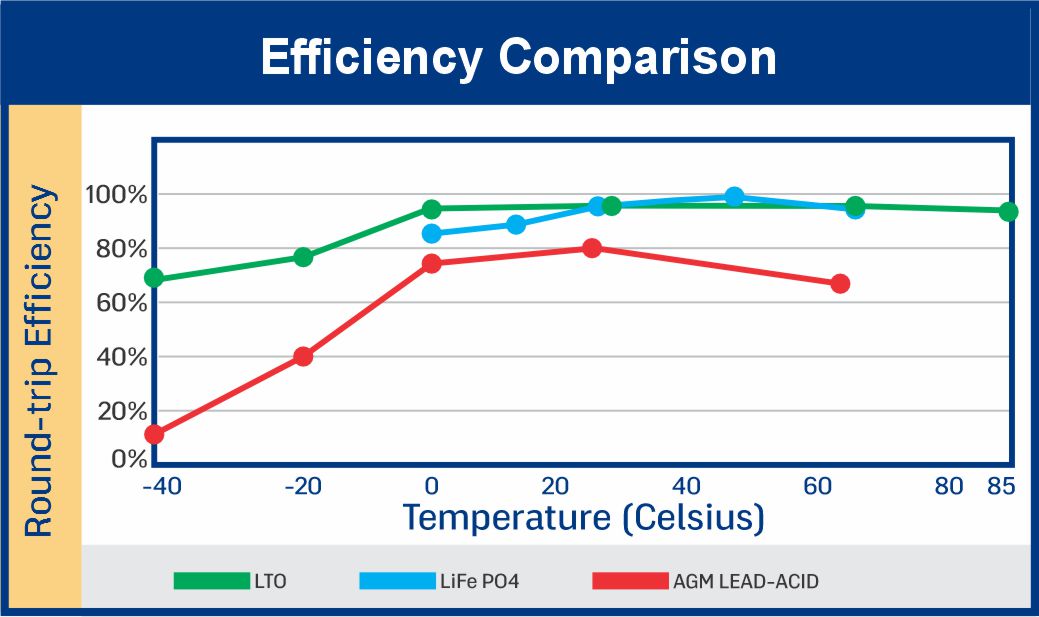
TITAN LTO is fundamentally more robust than Lead-Acid. While Lead-Acid batteries suffer permanent capacity loss if left below 100% SOC, TITAN Immortal batteries are not damaged by a Partial State of Charge (PSOC), and only very slightly if left fully discharged. LTO will not degrade during low-light weeks and maintains a higher voltage at low temperatures, whereas Lead-Acid suffers voltage sag and life-shortening sulfation. Unlike Lead-Acid, LTO can be stored or left idle for years without self-discharging.

Extended Lifespan
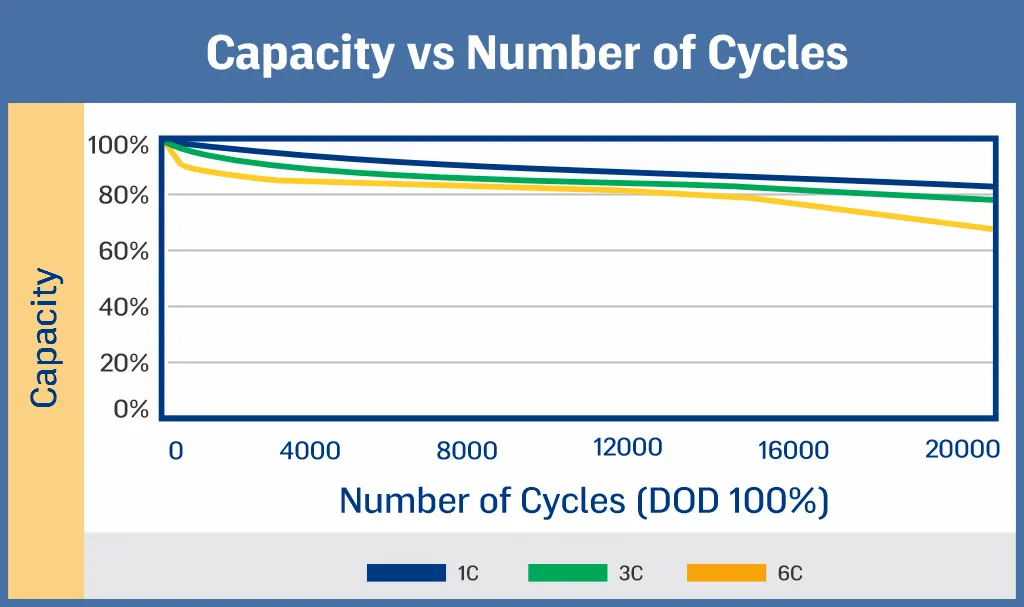
While a well-managed Deep Cycle Lead-Acid battery operating at moderate temperatures may achieve 1,000 to 1,500 cycles, Titan LTO provides 20,000 to 30,000 cycles - lasting decades - even under full 100% depth-of-discharge use.

Industry-Leading LCOS for Energy Storage
While the price per kilowatt-hour is higher, you will need much less of it, and it will last much longer. That is why the Levelized Cost of Energy Storage (LCOS)—the total cost per kWh delivered over the battery's life—is the lowest in the industry. TITAN LTO outlasts Lead-Acid by 10 - 20 times, and standard Lithium (LiFePO4) by 4 – 5 times. So even in temperate climates, LTO is the proven most cost-effective long-term investment.

Exceptionally-High Power Delivery
Along with their efficiency, longevity, and cold-weather performance, LTO is capable of extremely high charge and discharge rates. Along with all the other features of LTO, this high-current capability opens the door for LTO to replace Lead-Acid Starter Batteries. Specially made to be compatible with automotive charging systems, a 12V/40Ah Immortal Cold-Weather Starter Battery weighing just 9kg (21lbs) will start a truck in -40C for the life of your vehicle. From Storage to Starter Batteries, it is time to “Get the Lead-Out.”

Safety Features
Unlike Lead-Acid, TITAN Immortal batteries include an integrated Battery Management System (BMS). This electronic "brain" monitors each cell to prevent over-voltage, under-voltage, excess current-draw (such as a short-circuit) and will allow your batteries to operate from -45C to +85C. Cell balancing ensures all cells are charged equally (“balanced”), which in the long run extends the life of your battery. Also, in the event of a failure or external fire-event, LTO does not vent flammable gasses, and is not subject to thermal runaway. Overall, TITAN LTO provides a level of safety Lead-Acid cannot match.

Improved Performance and Longevity with a Drastic Reduction in Size & Weight
No limitations upon depth of discharge (DOD), coupled with superior efficiency means that for cold-weather applications, you can typically reduce your Lead-Acid Amp-hour (Ah) capacity to at least one-third of your previous Lead-Acid requirement. This results in a reduction of space requirement by at least 50%, and a reduction in weight by 80%.